FATHER JOHN HUDLESTON
This article emanated from Millom Castle, the Hudlestons and the English Civil Wars project.
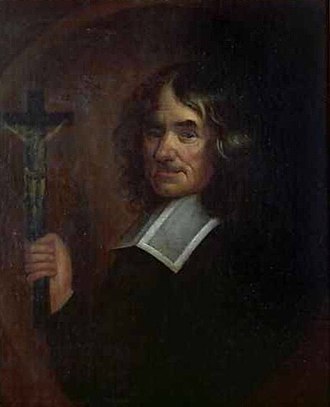
Father John Hudleston, after a portrait by John Huysmans. Public Domain
Relationship with Millom Hudlestons
Father John Hudleston's grandfather, Andrew Hudleston (1532-1601) was the brother of Colonel Sir William Hudleston's
great grandfather, Anthony Hudleston (1519-1598). Both were sons of Sir John Hudleston (1488-1547); thus they are second
cousins, one generation removed.
The Hutton John Hudleston branch began when Father John's grandfather, Andrew, married his third wife, Marie, who was the
daughter of Cuthbert Hutton of Hutton John. The Hutton John Estate is just over six miles south west of Penrith, and just
under three miles south of Greystoke Castle. The Hudlestons owned the Hutton John Estate from 1570 to 1986.
Father John's story is well documented; and his genealogy is preserved by a Hudleston descendent, Annette Hudleston
Harwood of Hutton John. Here is an outline of his story.
John was one of eleven children, and was educated at Blencowe Grammar School near Penrith, followed by the English Jesuit
college, Saint-Omer in northern France. He concluded his studies at the English College in Rome, being ordained a priest
in 1637. He became chaplain to John Preston of Furness Abbey and, according to Annette Hudleston Harwood, Father John
was present at the Lindal skirmish, probably as a military chaplain as he was unable to bear arms due to his priestly vows.
King Charles II in Hiding
After being defeated at the Battle of Worcester, on 3rd September, 1651, King Charles II went into hiding. He spent several
days travelling, first near Kidderminster then, on 6th September, he had to hide in an oak tree near Boscobel House, where
he then stayed in the priest's hole before leaving for Moseley Hall. It was there that Father John Hudleston was tutor
for the little Sir John Preston, and Thomas Whitgreave's two nephews.
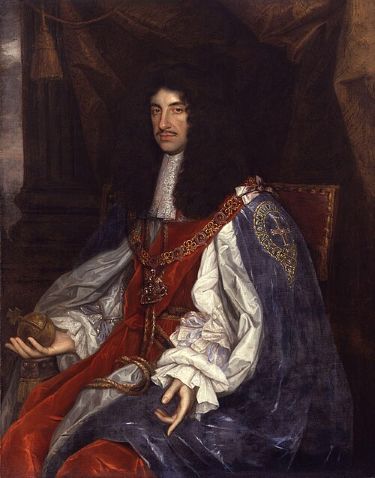
King Charles II, c. 1660-65. By John Michael Wright. Public Domain
Father Hudleston looked after King Charles:
Mr. Hudleston, observing the coarsness of His Majesties shirt to dis-ease him much and hinder his rest, asked my Lord,
if the King would be pleased to change his shirt, which His Majesty condescended unto, and presently put off his coarse
shirt and put on a flaxen one of Mr. Hudleston's who pulled off His Majesties shooes and stockens, and put him on fresh
stockens and dryed his
Feet...
King Charles spent a night and two days at Mosely Hall, sleeping in Father John's bed, but was forced to hide in the priest
hole when Parliamentary troops arrived at the Hall searching for him. During this time Father John took care of him. The
king then escaped via Bristol to France.
According to Annette Hudleston Harwood, whilst at the hall the king read one of Father John's books,
A Short and
Plain Way to the Faith and Church written by Father John's uncle, Father Richard Hudleston. Being touched by Father
John's care, King Charles is believed to have said,
"If it please God I come to my crown, both you and all your persuasion
shall have as much liberty as any of my subjects."
King Charles II did not forget his promise to Father John (but not to Catholics in general). After the Restoration in 1660,
the King appointed Father John chaplain to the Queen Dowager (Henrietta Maria), with quarters at Somerset House, where John
was immune from religious persecution. When Henrietta Maria died, Father John became chaplain to Queen Catherine of Braganza,
with a salary and pension of two hundred pounds. He officiated at several marriages at St James' Royal Catholic Chapel, and Somerset House.
In 1674 an order was issued in council that
"all Catholic priests born within his Majesty's dominions, with the exception of
Father Hudleston, to leave the kingdom before the 25th March next following and not to return." Similarly, during the
anti-Catholic riots of 1678, there was a bill "exempting Father Hudleston and others who had helped the King, from the
penalties of the laws against recusants...they should live as freely as any of his Majesty's Protestant subjects..."
Death of King Charles II
When Charles II was dying in 1685, he declined the English communion from his chaplain, the Bishop of Bath and Wells.
Someone suggested to his brother, the Duke of York, who would become King James II - that the King's sympathies lay with
the Catholic Faith. Father John was found and, disguised in a wig and cassock, was admitted by the back stair to the King's
chamber. The King is said to have remembered Father John and said to him,
"You that saved my body are now come to save my
soul."
Annette Hudleston Harwood tells us that Charles made his confession, received extreme unction, was then anointed with oil
and took the Catholic communion. Father John prayed with him for a while and holding a crucifix before the king, gave him the
blessing, and then retired. Charles appeared to rally after the last rites, but finally died on the morning of Friday,
6th February.
After the death of Charles II, Father John stayed in the household of the Queen Dowager, and in 1688 republished his uncle's
book,
A Short and Plain Way to the Faith and Church, to which is annexed the papers of King Charles II found in his closet
after his death, plus Father John's brief account of what occurred on the King's deathbed. This is available free, on-line,
thanks to the University of Michigan's Library Digital Collections, but here is Father John's account of the death of
Charles II:
A Brief Account of particulars occurring at the happy Death of our late Sovereign Lord King CHARLES II. in regard to Religion;
faithfully related by his then Assistant, Mr John Hudleston.
Upon Thursday the Fifth of February, 1685. Between Seven and Eight a Clock in the Evening, I was sent for in hast to the
Queens Back stairs at Whitehall, and desired to bring with me all things necessary for a dying Person. Accordingly I came,
and was order'd not to stir from thence till further notice; being thus obliged to wait, and not having had time to bring
along with me the Most Holy Sacrament of the Altar, I was in some Anxiety how to procure it: In this conjuncture (the Divine
Providence so disposing) Father Bento de Lemos a Portugez came thither, and understanding the circumstance I was in, readily
profer'd himself to go to St. James's and bring the Most Holy Sacrament along with him.
Soon after his departure I was call'd into the Kings Bed Chamber, where approaching to the Bed side, and Kneeling down, I in
brief presented his Majesty with what service I could perform for God's honor, and the happiness of his Soul at this last
Moment on which Eternity depends. The King then declared himself, That he desired to die in the Faith and Communion of the
Holy Roman Catholic Church, That he was most heartily sorry for all the Sins of his life past, and particularly for that
he had deferred his Reconciliation so long; That through the Merits of Christ's Passion he hoped for Salvation, That he
was in Charity with all the World; that with all his heart he Pardon'd his Enemies and desired Pardon of all those whom
he had any wise offended, and that if it pleased God to spare him longer Life, he would amend it, detesting all Sin.
I then advertis'd His Majesty of the benefit and necessity of the Sacrament of Penance, which advertisement the King most
willingly embracing, made an exact Confession of his whole Life with exceeding Compunction and Tenderness of Heart, which
ended, I desired him, in farther sign of Repentance and true sorrow for his Sins, to say with me this little short Act of
Contrition.
O my Lord God, with my whole Heart and Soul I detest all the Sins of my Life past for the Love of Thee, whom I love above
all things, and I firmly purpose by thy Holy Grace never to offend thee no more, Amen Sweet Jesus. Amen. Into thy hands sweet
Jesus I commend my Soul, Mercy, sweet Jesus, Mercy. This he pronounced with a clear and audible voice, which done, and his
Sacramental Penance admitted, I gave him Absolution.
After some time thus spent, I asked His Majesty, if he did not also desire to have the other Sacraments of the Holy Church
administred to him? He replyed, by all means, I desire to be partaker of all the helps and succours necessary and expedient
for a Catholic Christian in my condition. I added, and doth not your Majesty also desire to Receive the Pretious Body and
Blood of our dear Saviour Jesus Christ in the Most Holy Sacrament of the Eucharist? His Answer was this: If I am worthy,
pray fail not to let me have it. I then told him, it would be brought to him very speedily and desired his Majesty,
that in the interim he would give me leave to proceed to the Sacrament of Extreme Unction, he replyed with all my Heart;
I then anointed him, which as soon as perform'd I was called to the Door, whither the blessed Sacrament was now brought
and delivered to me.
Then returning to the King, I entreated His Majesty, that he would prepare and dispose himself to receive. At which the King
raising up himself, said, let me meet my Heavenly Lord in a better posture than in my Bed. But I humbly begg'd His Majesty to
repose himself: God Almighty who saw his Heart would accept of his good intention. The King then having again recited the
forementioned Act of Contrition with me, he received the Most Holy Sacrament for his Viaticum with all the Symptoms of
Devotion imaginable. The Communion being ended I Read the usual Prayers, termed the Recommendation of the Soul, appointed
by the Church for Catholics in his condition. After which the King desired the Act of Contrition: O my Lord God, &c. to be
repeated, this done, for his last Spiritual encouragement I said.
Your Majesty hath now received the Comfort and Benefit of all the Sacraments, that a good Christian (ready to depart out
of this World) can have or desire. Now it rests only, That you think upon the Death and Passion of our Dear Saviour Jesus
Christ of which I present unto you this Figure (shewing him a Crucifix) lift up therefore the Eyes of your Soul and represent
to your self your sweet Saviour here Crucified: Bowing down his Head to Kiss you: His Arms stretched out to Embrace you: His
Body and Members all Bloody and Pale with Death to Redeem you: And as you see him Dead and fixed upon the Cross for your
Redemption; So have his Remembrance fixed and fresh in your Heart: beseech him with all Humility, that his most precious
Blood may not be shed in vain for you: And that it will please him by the Merits of his bitter Death and Passion to pardon
and forgive you all your Offences, and finally to receive your Soul into his blessed Hands, and when it shall please him to
take it out of this Transitory World, to grant you a joyful Resurrection and an Eternal Crown of Glory in the next. In the
Name of the Father, and of the Son, and of the Holy Ghost, Amen.
So Recommending His Majesty on my Knees, with all the Transport of Devotion I was able, to the Divine Mercy and Protection
I withdrew out of the Chamber.
In Testimony of all which I have hereunto subscribed my Name. JO. HUDLESTON.
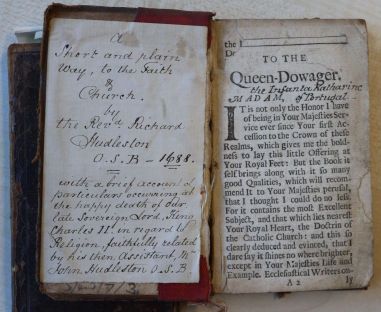
A Short and Plain Way to the Faith and Church, Cumbria Archive, Carlisle. Jonathan Brind
Anti-Catholic Feelings/Protestantism
In 1688 anti-Catholic feelings were at their height. Queen Mary Beatrice, the second wife of James II, gave birth to a
long-awaited son, James Francis Edward. Malicious rumours circulated regarding his birth, possibly at the instigation of
James's two Protestant daughters, Mary and Anne. Anti-Catholic feelings were at their height and the invasion of England
by the Protestant Prince William of Orange, married to Princess Mary, was imminent.
Ironically, Father John's nephew, Andrew Hudleston of Hutton John, along with Sir James Lowther, were amongst the Protestant
conspirators. At Workington they seized a ship carrying arms and ammunition that was headed for King James' garrison at
Carlisle. The king fled to France with his wife and son, and in February 1689, the Crown was given to William and Mary -
who were crowned joint sovereigns in April that year.
Father John remained chaplain to the Queen Dowager, and continued to receive exemption from the Acts against Catholicism.
His pension was paid by William III. He died in 1698 aged 90, and is buried at St. Mary le Strand, also known as the
Chapel of the Savoy, near Somerset House.
He wrote his will in 1693 whilst under the protection of Lord Feversham, who was present at the death of Charles II and
had also converted to Catholicism. It seems Father John changed his will in favour of his relatives in Sawston, leaving
his relatives at Hutton John (his nephew Andrew and family) only enough money to buy mourning rings. His nephew Andrew
and his children supported King William and Queen Mary, and Protestantism, whilst the Hudlestons of Sawston remained
Catholic.
Andrew and his daughter Frances visited Father John in 1697, angry that Father John had changed his will. They made an
inventory of Father John's belongings, but were prevented from taking anything by a servant. They petitioned for
custody of Father John, but Lord Feversham obtained an order from the Lord Chancellor for him to continue as Father
John's guardian.
Andrew Hudleston and his family of Hutton John were not the only ones to support William and Mary: there is a list of
some 900 names of men from the Millom seigniory who signed an oath declaring support for William and Mary, and Protestantism,
dated 1690. This is held at Carlisle Archive, and is part of the Senhouse family collection. They have given kind
permission
"to community groups and other not for profit organisations to promote learning and outreach activity."
The list has been transcribed by Susan Cawthorne and can be accessed on Millom and District Local History website;
it includes 14 Hudlestons.
Father John's Missal Found
One final point with regard to Father John: his missal (prayer book used to convert King Charles II was recently acquired
by the National Trust and is on show at Moseley Old Hall. It seems that the missal was found in 1950 in a book shop in
Liverpool by a Mr. Joseph J. Proctor who bought it for six old pence. The book was missing its spine and front cover but
Mr. Proctor saw the signature of Father John Hudleston on the front page; he thought it might have some historic value so
had it bound. Mr. Proctor lent the book to a Catholic exhibition in Liverpool, as a result of which, it was discovered that
it was Father John's personal missal.